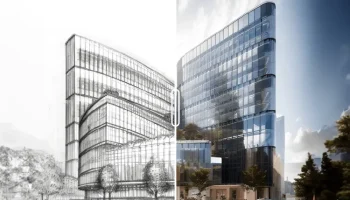


“Artificial Intelligence has no place in construction.” This bold statement is echoed by skeptics who view AI as a disruptive force in an industry grounded in human expertise and traditional workflows. Construction projects are complex, involving diverse stakeholders, meticulous planning, and precise execution. Many fear that introducing AI tools into this intricate ecosystem could cause more harm than good.
Yet, as digital transformation sweeps through industries, AI is steadily finding its place in construction. From AI-powered BIM platforms to predictive analytics and robotics, the tools are evolving rapidly. This raises an important question: why AI shouldn’t be used in construction? By examining the most common concerns—complexity, costs, risks, and creativity—this article seeks to challenge the assumptions behind this skepticism and explore how AI might instead revolutionize the construction industry.
1. Why AI shouldn’t be used in construction: It’s too complex to adopt... or is it?
The fear of complexity often blinds us to the simplicity of solutions.
Critics argue that AI adoption in construction adds unnecessary complexity to an already demanding industry. With layers of coordination among architects, engineers, contractors, and managers, the thought of introducing AI-powered tools like BIM platforms and automated scheduling systems can feel overwhelming.
However, modern AI tools are designed to streamline workflows, not complicate them:
- Simplified interfaces: AI tools often feature user-friendly designs, enabling professionals to adopt them with minimal training. Platforms like Autodesk BIM 360 automate tasks like clash detection and design validation.
- Centralized communication: AI platforms improve collaboration by consolidating project data, ensuring that all stakeholders access up-to-date information.
- Plug-and-play integration: Many AI solutions integrate seamlessly with traditional ERP and BIM systems, minimizing disruption during implementation.
While the initial learning curve may require effort, these tools ultimately simplify processes, reduce errors, and foster better collaboration across teams.
Discover the BIM tools that already integrate AI
2. Why AI shouldn’t be used in construction: It replaces humans... or empowers them?
AI doesn’t take jobs; it transforms them.
One of the most persistent fears about AI is that it will replace human workers, particularly in roles heavily reliant on manual labor. Automation of tasks like material tracking, scheduling, or even site monitoring may seem like a threat to job security. However, this perspective often underestimates AI’s potential to complement rather than compete with human skills.
AI enables workers to focus on tasks requiring creativity and decision-making by automating repetitive processes. For instance, AI-powered drones monitor site progress, freeing managers to focus on strategic planning. Additionally, computer vision systems enhance safety by detecting hazards in real-time, reducing on-site accidents and protecting workers.
The rise of AI also creates opportunities for upskilling. Employees can be trained to operate and interpret data from AI tools, expanding their expertise and opening doors to higher-value roles. Rather than replacing humans, AI acts as a partner that enhances their capabilities and improves workplace safety and efficiency.

3. AI stifles creativity... or unleashes it?
Creativity is not limited by tools—it is amplified by them.
In architecture, creativity lies at the heart of the profession. Some argue that relying on algorithms to generate designs could lead to generic, uninspired structures. If AI creates layouts and forms, does it leave room for human innovation?
The answer lies in how AI enhances creativity:
- Generative design tools: Tools like Autodesk Dreamcatcher allow architects to input parameters—such as material constraints, site conditions, and budget—and generate hundreds of design options. These solutions inspire creativity by offering possibilities that might otherwise be overlooked.
- Enhanced visualization: AI-powered software like Enscape and Lumion produces photorealistic renders, helping architects refine their ideas and communicate them more effectively to clients.
- Faster iterations: AI tools enable teams to experiment with multiple design variations in a fraction of the time, encouraging bolder and more innovative ideas.
Rather than stifling imagination, AI empowers architects to push boundaries and explore new possibilities, leaving the human touch at the core of the creative process.
Explore different Image Generation Tools now!
4. Why AI shouldn’t be used in construction: It’s too expensive... or a cost-saving powerhouse?
Investment in the future often feels like a cost today.
One of the primary criticisms of AI adoption is its perceived expense. The upfront cost of implementing AI solutions, training staff, and integrating systems can seem unattainable, especially for smaller firms. However, these short-term costs are often outweighed by the long-term savings AI brings.
For example, material optimization is one of AI’s key strengths. Algorithms calculate the exact quantities of materials required, reducing waste and preventing unnecessary expenses. Similarly, predictive scheduling tools anticipate delays caused by weather, supply chain disruptions, or labor shortages, enabling teams to mitigate these challenges and avoid costly overruns.
Another significant area of savings comes from predictive maintenance. AI-powered systems monitor equipment for signs of wear and tear, allowing timely repairs and extending machinery lifespan. While the initial investment might seem daunting, the overall reduction in material waste, delays, and maintenance costs proves AI’s value as a cost-saving powerhouse over time.
5. AI increases risks... or mitigates them?
Risk doesn’t disappear—it shifts.
Another common argument against AI adoption is that it introduces new risks. Errors in algorithms, reliance on technology, and data security concerns are often cited as reasons to hesitate. While these risks are valid, they are outweighed by the risks AI helps mitigate:
- Predictive analytics: AI can identify potential design flaws or structural failures before construction begins, minimizing the likelihood of costly errors during the build phase.
- Real-time safety monitoring: AI-powered drones and sensors ensure compliance with safety protocols and detect hazards on-site, significantly reducing the risk of accidents.
- Scenario modeling: AI tools simulate multiple project scenarios, enabling teams to choose the safest and most cost-effective approaches.
By improving visibility, foresight, and control, AI reduces overall project risks and ensures that teams can respond quickly to unforeseen challenges. Far from increasing uncertainty, AI enhances safety and reliability across construction projects.
Explore new solution for Building Maintenance!
6. Why AI shouldn’t be used in construction: It doesn’t fit traditional processes... or does it?
The best innovations build on tradition, not replace it
Construction has a reputation for being a conservative industry, deeply rooted in traditional practices. Many professionals believe that AI tools are too disruptive, requiring a complete overhaul of workflows honed over decades. However, AI’s strength lies in its ability to enhance, rather than replace, established processes.
For instance, AI-powered BIM systems integrate seamlessly into traditional workflows, improving collaboration between architects, contractors, and engineers. These tools automate repetitive tasks like clash detection while preserving the decision-making expertise of professionals. On-site, AI-powered robotics (Dusty Robotics for example) assist with labor-intensive tasks such as bricklaying and welding, allowing workers to focus on higher-value activities.
Rather than forcing construction to abandon its roots, AI provides tools that elevate the industry to meet modern demands. By complementing existing systems, AI ensures that tradition and innovation can coexist, creating better outcomes for all stakeholders.

Turning Challenges into Opportunities
Every challenge AI faces in construction is also its greatest opportunity
Why shouldn’t AI be used in construction? While concerns about complexity, cost, risks, and creativity are valid, they ultimately miss the bigger picture. AI is not a threat—it’s a transformative tool that simplifies processes, empowers workers, enhances creativity, and reduces risks.
By embracing AI, the construction industry can move toward a future that is safer, more efficient, and more innovative. It’s time to stop asking why AI shouldn’t be used and start exploring how it can revolutionize the field, turning challenges into opportunities and ideas into reality.
In the meantime, browse the full range of AI tools available for the world of architecture and construction